

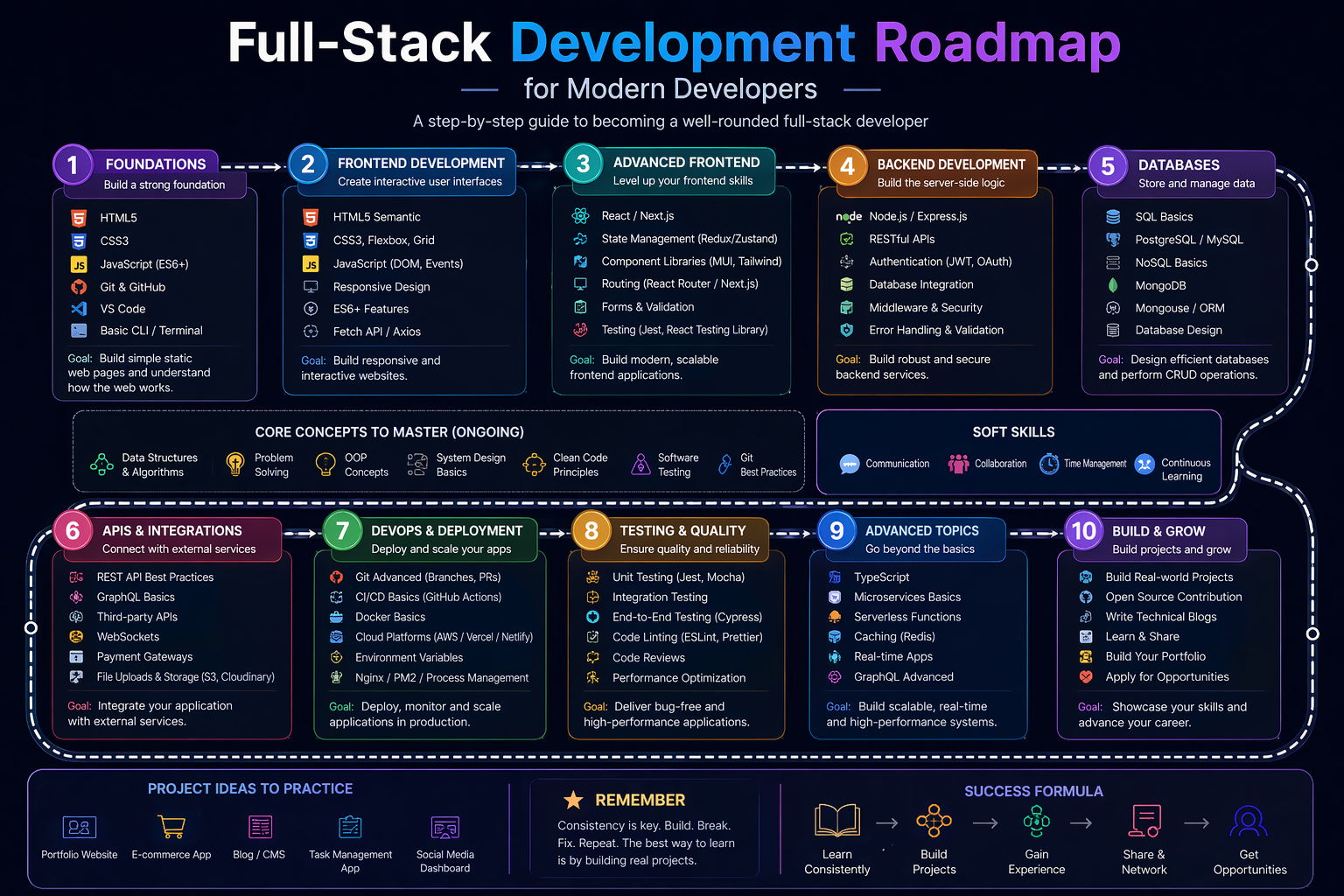
Full-Stack Development Roadmap for Modern Developers (2026 Complete Guide)
Author: Malik Mohsin Saleem Khan
Introduction
Full-stack development has become one of the most in-demand and powerful skill sets in modern web development. A full-stack developer is someone who can work on both the frontend (client-side) and backend (server-side) of a web application, including databases, APIs, and deployment processes.
In 2026, the role of a full-stack developer has evolved significantly. Developers are no longer just writing code; they are building scalable systems, optimizing performance, integrating AI tools, and managing cloud-based infrastructure.
This article provides a complete, structured roadmap for becoming a modern full-stack developer, covering everything from fundamentals to advanced technologies and real-world practices.
What is Full-Stack Development?
Full-stack development refers to the ability to develop both the frontend and backend of web applications. It includes everything needed to build a complete product from start to finish.
Key Areas of Full-Stack Development
- Frontend development (UI/UX)
- Backend development (server logic)
- Database management
- API development and integration
- Deployment and DevOps
Why Full-Stack Development is Important
Full-stack developers are highly valuable because they:
- Understand entire application architecture
- Can work independently on complete projects
- Improve communication between frontend and backend teams
- Reduce development time and cost
Step 1: Learning the Fundamentals of Web Development
Before becoming a full-stack developer, you must understand the basics of web development.
Core Technologies
HTML (Structure)
HTML forms the structure of web pages. It defines elements such as headings, paragraphs, forms, and links.
CSS (Styling)
CSS is used to design and style web pages, including layouts, colors, spacing, and responsiveness.
JavaScript (Functionality)
JavaScript adds interactivity and dynamic behavior to websites.
Why Fundamentals Matter
Without strong fundamentals, advanced topics become difficult to understand and implement effectively.
Step 2: Mastering Frontend Development
Frontend development focuses on everything users see and interact with in a web application.
Modern Frontend Technologies
- React.js
- Vue.js
- Angular
- Next.js
- Tailwind CSS
Key Frontend Skills
- Responsive design
- Component-based architecture
- State management
- API integration
- UI/UX principles
Important Concepts
Component-Based Development
Breaking UI into reusable components improves scalability and maintainability.
State Management
Managing application data efficiently using tools like Redux or Context API.
Step 3: Backend Development Fundamentals
Backend development handles server-side logic, databases, authentication, and APIs.
Popular Backend Languages
- Node.js (JavaScript)
- Python
- Java
- PHP
- Go
Backend Frameworks
- Express.js
- Django
- Spring Boot
- Laravel
Core Backend Responsibilities
- Handling user requests
- Processing business logic
- Managing authentication
- Communicating with databases
Step 4: Working with Databases
Databases are essential for storing and managing application data.
Types of Databases
SQL Databases
- MySQL
- PostgreSQL
- SQLite
Structured and relational databases used for complex queries.
NoSQL Databases
- MongoDB
- Firebase
- CouchDB
Flexible databases used for scalable applications.
Key Database Concepts
- Tables and collections
- Relationships
- Queries
- Indexing
- Data normalization
Step 5: APIs and Communication
APIs connect frontend and backend systems.
What is an API?
An API allows different software systems to communicate and exchange data.
Types of APIs
- REST APIs
- GraphQL APIs
- WebSockets
Why APIs are Important
- Enable frontend-backend communication
- Allow third-party integrations
- Support mobile and web applications
Step 6: Version Control Systems
Version control is essential for managing code efficiently.
Git and GitHub
Git is a version control system, while GitHub is a platform for hosting repositories.
Key Git Commands
- git init
- git add
- git commit
- git push
- git pull
Benefits
- Track code changes
- Collaborate with teams
- Manage project history
Step 7: Full-Stack Development Stacks
A stack is a combination of technologies used in development.
Popular Full-Stack Stacks
MERN Stack
- MongoDB
- Express.js
- React.js
- Node.js
MEAN Stack
- MongoDB
- Express.js
- Angular
- Node.js
LAMP Stack
- Linux
- Apache
- MySQL
- PHP
Step 8: Authentication and Security
Security is critical in full-stack applications.
Authentication Methods
- JWT (JSON Web Tokens)
- OAuth
- Session-based authentication
Security Best Practices
- Encrypt sensitive data
- Validate user input
- Use HTTPS
- Prevent SQL injection
- Secure APIs
Step 9: Deployment and Hosting
Deployment is the process of making applications live on the internet.
Popular Hosting Platforms
- Vercel
- Netlify
- AWS
- DigitalOcean
- Heroku
Deployment Steps
- Build application
- Configure environment variables
- Connect database
- Deploy backend and frontend
- Test production environment
Step 10: DevOps and CI/CD
DevOps improves development efficiency through automation.
CI/CD Explained
- Continuous Integration
- Continuous Deployment
Benefits
- Faster deployment
- Fewer bugs
- Automated testing
- Improved collaboration
Step 11: Advanced Full-Stack Concepts
Microservices Architecture
Breaking applications into smaller independent services.
Serverless Computing
Running backend functions without managing servers.
Edge Computing
Processing data closer to users for better performance.
Step 12: Performance Optimization
Performance is critical for user experience and SEO.
Optimization Techniques
- Code splitting
- Lazy loading
- Caching
- Image optimization
- Database indexing
Step 13: Real-World Project Building
To become a skilled full-stack developer, practice is essential.
Project Ideas
- E-commerce platform
- Blog application
- Chat application
- Portfolio website
- Task management system
Why Projects Matter
- Build real experience
- Improve problem-solving skills
- Strengthen portfolio
Step 14: Tools Every Full-Stack Developer Should Know
Development Tools
- VS Code
- Postman
- Docker
- Figma
Productivity Tools
- GitHub
- Notion
- Jira
Step 15: Future of Full-Stack Development
Full-stack development is evolving rapidly with new technologies.
Future Trends
- AI-assisted development
- No-code integration
- Serverless-first architecture
- Edge computing growth
- Automation in deployment
Role of AI
AI will assist developers in coding, debugging, and optimization, increasing productivity significantly.
Conclusion
Full-stack development is one of the most powerful and future-proof career paths in web development. It requires mastery of both frontend and backend technologies, along with databases, APIs, deployment, and modern tools.
By following this roadmap, developers can build complete, scalable, and production-ready applications. In 2026 and beyond, full-stack developers will play a key role in shaping the digital world through efficient, intelligent, and high-performance web applications.